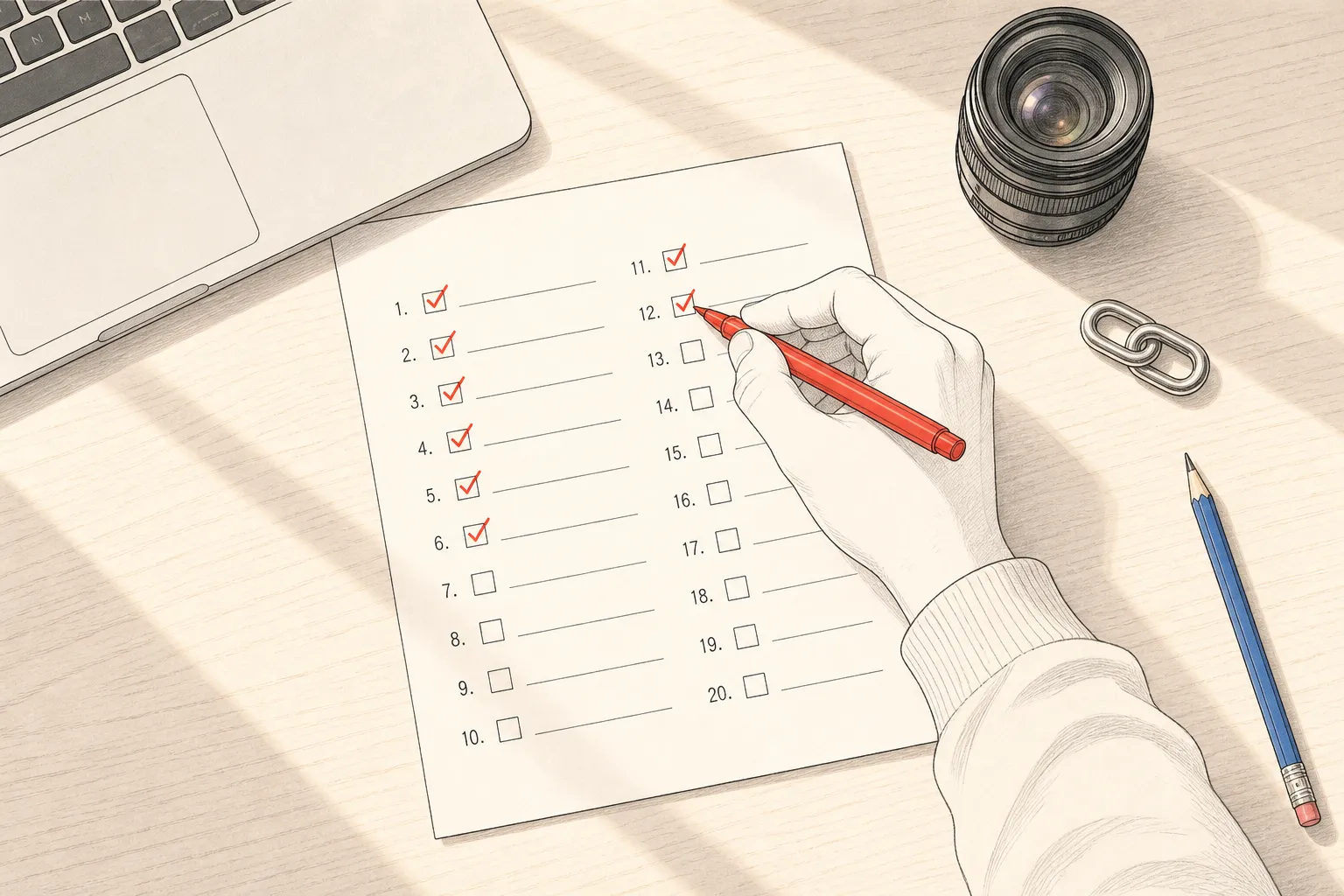
A solid draft is not enough. One vague title, a missing canonical, or a 3 MB hero image can bury a great post. Use this fast, final pass to tighten on-page SEO, prevent technical mistakes, and set your post up to rank and appear in AI answers.
Work through the 20 checks below. Each one tells you what to do, why it matters, and a quick example so you can publish with confidence.
Before you publish: your 20-point checklist
- Lock one primary intent and keyword. Pick a single problem the reader is trying to solve and a primary term that matches it. Example: if intent is “how to choose a CRM,” your keyword might be “best CRM for small business,” not a mix of “CRM pricing” or “CRM migration.”
- Scan the top SERP and match format. Check the first page results. If most are step-by-step guides or comparison lists, mirror that shape. Add what competitors miss, like a short scoring rubric or a decision tree.
- Write a title tag under 60 characters. Use the primary term and a clear outcome. Aim for under ~575 pixels. Example: “CRM Selection Guide: Choose the Right Tool in 7 Steps.”
- Craft a meta description that sells the click. In 140–155 characters, echo the intent and add one concrete benefit. Example: “Use this 7-step CRM guide with a scoring sheet to compare vendors and pick the right fit in under an hour.”
- Set a short, human-readable URL slug. Include the main keyword and trim stop words. Example: /blog/crm-selection-guide not /blog/12345?ref=home.
- Use a clear H1 that matches the promise. Keep it natural and close to the title. Do not stuff variants. If the title is benefit-led, the H1 can be identical or a plain version.
- Structure H2s and H3s for skimmers. Make each section answer one job-to-be-done. Use parallel phrasing. Example H2s: “Who this works for,” “Steps,” “Checklist,” “Common snags,” “Next actions.”
- State the answer early. In the first 150–200 words, give a direct, quotable summary. Follow with a 3–5 item list of the key steps. This helps win snippets and fuels AI answer extraction.
- Cover required entities and terminology. Name the tools, standards, and concepts the topic demands. Example for page speed: Core Web Vitals, LCP, INP, CLS, lazy-loading, CDN, WebP, server TTFB. This signals topical completeness.
- Add 2–4 relevant internal links. Point to a revenue page and related posts with descriptive anchors. Example: “See our CRM comparison template” not “click here.” Keep links dofollow and avoid repeating the same anchor back-to-back.
- Reference one or two credible external sources. Cite an industry report, standard, or dataset when you make a claim with numbers. Mention the source in prose so readers can verify it.
- Include at least one unique element. Add an original example, mini case note, or screenshot. Example: a filled scoring matrix for three CRM vendors with criteria and weights.
- Write image alt text that describes function. Explain what the image shows in context. Example: “CRMs ranked by score in a weighted comparison table,” not “screenshot.” Keep decorative images empty alt.
- Compress images and set dimensions. Export WebP or AVIF where supported. Keep hero images under ~150 KB if possible. Include width and height attributes to prevent layout shifts. Lazy-load below-the-fold media.
- Check readability and flow. Use short paragraphs, 1 idea per sentence, and active voice. Aim for a grade 6–8 reading level. Read it aloud once to catch friction.
- Add a relevant FAQ block if useful. Keep Q&As concise and factual so they can earn snippets. Store the FAQ in your page’s FAQ field and use FAQ schema. Do not bury it mid-article.
- Place one clear, contextual CTA. Offer the next step that fits reader intent. Example: “Download the scoring template” or “Compare plans.” Avoid stacking CTAs.
- Confirm indexability and canonicals. Ensure HTTP 200, meta robots is index, follow, and there is a self-referencing canonical. Check for noindex in HTTP headers. Include the URL in your XML sitemap and test with URL Inspection.
- Localize or add hreflang correctly. For language or market variants, add reciprocal hreflang pairs and x-default. Example: en-us, en-gb, es-es, each pointing to the others.
- Prepare for AI search with GEO basics. Add concise definitions, step lists, and a structured recap. Use consistent names and units. Summaries should be scannable and quotable so AI systems can extract them accurately.
Pro tip for original details. If you interview a subject matter expert for quotes or steps, tools like note1 make it easy to capture accurate transcripts and action items you can fold into the draft.
AI search visibility and GEO in plain English
AI overviews reward content that is clear, consistent, and easy to extract. Generative Engine Optimization, or GEO, is not about writing for robots. It is about packaging the same helpful content in predictable structures.
- Front-load answers. Open with a 2–3 sentence summary and a short list of steps. Example for “optimize images”: “Compress to WebP, set width and height, lazy-load, and preconnect to your CDN.”
- Use tight definitions. Keep them to one or two sentences. Example: “LCP is the time it takes for the largest element in the viewport to render.”
- Mark up what you can. Use Article and FAQ schema in JSON-LD. Keep facts in the body consistent with the schema, including dates and author.
- Stay consistent. Use the same product names, units, and spellings throughout. If you say 2.5 seconds once, do not say 2500 ms later.
These practices do not replace strong writing. They reduce ambiguity so AI systems summarize your post without errors.
Where automation helps without cutting corners
Some tasks repeat and are worth automating so you can spend time on research, examples, and editing. A done-for-you service can plan content in clusters around revenue pages, map keywords, propose internal link paths, and write posts on a steady cadence up to plan limits. Posts can ship with titles, meta tags, headers, alt text, internal links, and Article and FAQ schema handled out of the box.
If AI search is a priority, look for AI search optimization features that track inclusion in AI answers and apply GEO-aligned tweaks, like clearer definitions, structured recaps, and consistent terminology. Technical SEO cleanup should cover weekly indexing checks and fixes for soft 404s, duplicate content, sitemap gaps, canonical mismatches, and stray noindex directives.
Backlinks still matter. A reliable workflow is to place a single contextual dofollow link per new post from a vetted partner and monitor link status daily. If a partner drops or nofollows a link, replace or reroute it so the page retains equity. Keep anchors natural and relevant to the destination page.
Localization also benefits from automation. Multilingual publishing should detect your site’s base language, write natively for each market, and wire correct hreflang linking so the right audience sees the right version.
For quick spot checks, lean on simple tools: a Domain Rating checker to sanity check authority ranges for outreach, an SEO checker for meta, headings, and Core Web Vitals, a Sitemap checker to verify discoverability, and a SERP snippet preview to catch truncation before you publish.
Closing note. Consistency beats heroic one-offs. Run this checklist, publish, then improve the post with fresh examples, internal links, and GEO-friendly summaries as you learn what readers engage with.
Key takeaways
- One clear intent, tight on-page basics, and fast-loading media do most of the ranking work.
- Structure content for extraction so GEO improves your AI search visibility without diluting voice.
- Plan internal links and technical indexing checks before you publish to avoid avoidable rework.
- Automate repeatable tasks and consider a done-for-you blog writing service with a backlink building service when scale matters.