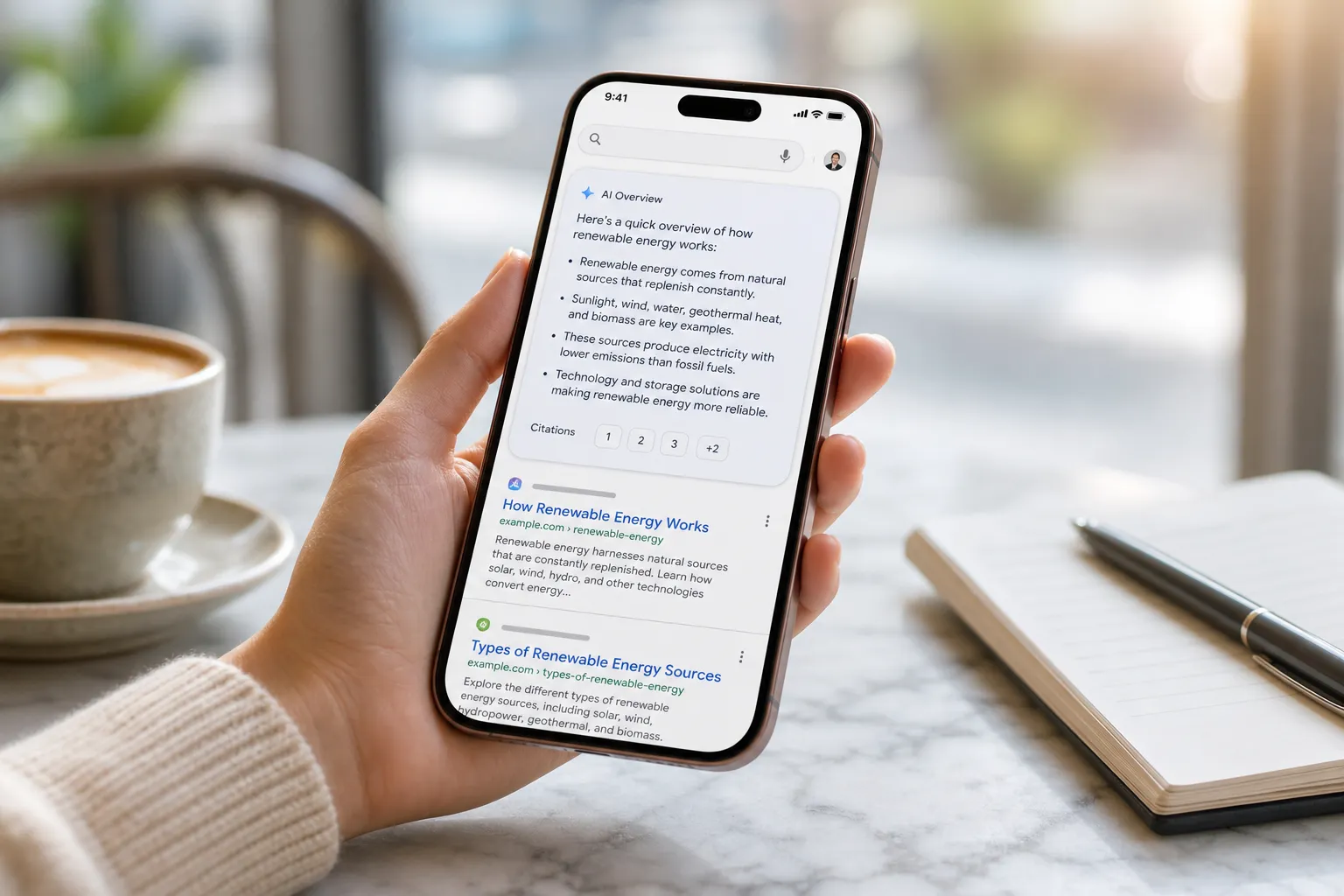
Your analytics do not lie. People still search, but they click and consume in new places that look more like chats and answer cards than a list of blue links. Across many sites in 2026, impressions rise while clicks per query dip. On informational and how-to topics, an AI answer now appears on a large share of results, and many users get what they need before visiting a site. If you want steady traffic, you need a plan that aligns to how search engines and generative engines decide what to cite.
Trend 1: AI answers are the first stop for many queries
What is changing
Generative results show up on a growing portion of queries and summarize the basics before a user ever visits a page. These AI answers cite a small set of sources, compress steps and definitions, and often satisfy the quick question. That shifts the competition from ranking anywhere on page one to being one of a few sources that the system trusts enough to quote.
What to do about it
- Adopt GEO. Generative Engine Optimization rewards pages that give a direct answer up top, then back it with specifics, examples, and corroboration. Write the one-sentence answer, follow with numbered steps or a concise framework, then add a proof section with stats, named entities, and references.
- Cover the entity set completely. List the key people, products, places, metrics, and acronyms that define the topic. For a “canonicalization guide,” that means canonical tags, parameters, duplicate clusters, pagination, hreflang, and CDN edge cases. Missing entities reduce your odds of citation.
- Use structure machines trust. Ship posts with clean titles, scannable H2s, descriptive alt text, and JSON-LD for Article, FAQ (when you are actually answering distinct questions), Organization, and WebSite. Include author, datePublished, and sameAs so models can resolve credibility.
- Plan clusters around money pages. Map a hub page to 6–12 supporting posts. Give each post a clear internal link path back to the hub with descriptive anchors. Models see that topology and infer authority at the hub.
- Track inclusion, not only rank. Set KPIs like “AI answer citation rate,” “snippet share,” and “co-citation with leaders.” Use an SEO automation tool that detects when your page appears in the AI card without a click and nudges on-page tweaks when you are close but not cited.
Trend 2: Indexation is scarcer, so technical basics decide growth
What is changing
Crawlers face an avalanche of pages. They respond by indexing selectively and punishing thin duplication. Small issues like inconsistent canonicals, soft 404s, infinite parameters, or orphaned URLs now compound into sections that never get indexed. New pages can sit in “Discovered, not indexed” for weeks if you do not guide bots.
What to do about it
- Run weekly index checks. In Search Console, segment by template or directory. Watch the ratio of Valid to Excluded and the trend of “Crawled, not indexed.” Verify that sitemaps only list indexable URLs and that canonical targets exist and return 200.
- Fix soft 404s and thin clusters. Consolidate near-duplicates with a canonical or a merge. Where intent is weak, noindex and remove from sitemaps. For faceted navigation, use parameter rules, block crawl traps in robots.txt, and link to a single canonical filter state.
- Repair discoverability. Ensure every indexable page has at least one followed internal link from a crawlable path. Add breadcrumb links, paginate with clear rel=canonical to page 1 for infinite scroll replacements, and surface fresh content in category hubs.
- Validate speed and render. Test a sample of pages with and without JS to confirm primary content and links are server-rendered or reliably hydrated. Keep CLS low and core content in HTML where possible so parsers see it.
- Automate the boring parts. An SEO automation tool that flags indexation blockers, fixes soft 404 patterns, updates sitemaps, and requests reprocessing on change cuts days from feedback loops and recovers crawl budget for revenue pages.
Trend 3: Backlinks shift from quantity to durability
What is changing
Links still signal authority, but unstable placements get ignored or vanish. Engines discount obvious swaps, networks, and sitewide junk. In a world where AI answers cite a handful of sources, the quality, topical fit, and longevity of links matter more than raw counts.
What to do about it
- Pick durable placements. Favor editorial in-article links on relevant pages with real traffic. Avoid footers, author bio-only links, or pages that flip to nofollow after a week. Aim for a 12-month survival rate target and track it.
- Balance anchors. Use natural phrases that match the context rather than exact-match spam. Keep any single money anchor under 10% of a page’s referring anchors. Mix branded, partial, and topical anchors to look like a real mention profile.
- Pair external with internal. When a new post earns a strong dofollow backlink, pass equity on purpose. Add 2–4 internal links from that post to the hub or product page it supports using descriptive anchors that match the target’s topic.
- Monitor daily and replace quickly. Keep a live sheet of placements with status, anchor, page target, and traffic. If a partner drops or nofollows your link, reroute or replace within 7 days so authority does not leak.
Trend 4: Short-form video primes search and informs AI answers
What is changing
Short video now acts as a query primer. People watch a 30-second explainer, then search with narrowed intent or tap a linked source. Generative engines ingest captions and transcripts to build their knowledge, which influences who gets cited in summaries.
What to do about it
- Repurpose every post into shorts. Use a 3-beat script: hook with the core answer, show one concrete example or step, then give a specific CTA to the full guide. Keep cuts tight and on-screen text readable.
- Use practical creation tools. A Faceless TikTok video maker can turn a prompt or a URL into on-brand shorts with script, visuals, voiceover, and MP4 export so you publish on a schedule.
- Make metadata carry weight. Upload SRT captions, align keywords to the post, add a clean UTM-tagged link, and pin a comment with the key takeaway. That helps both people and parsers map the clip to your page.
- Measure the assist. Tag posts with and without companion videos. Track changes in AI answer citations, assisted sessions, and dwell time to decide which topics deserve ongoing video support.
Putting it together without burning out
You need a cadence that covers content creation, link acquisition, technical cleanup, and ongoing AI search optimization. Doing all that manually is hard to sustain. A done-for-you blog writing service that also secures dofollow backlinks, fixes indexing and technical issues, ships schema, and watches AI answer inclusion lets you keep publishing while you run the business.
Use a simple weekly rhythm:
- Monday: Publish a hub-supporting post with a direct answer, entity checklist, and structured data.
- Tuesday: Launch 3–5 targeted outreach pitches for one durable backlink to that post.
- Wednesday: Sweep technical issues. Fix new coverage errors, soft 404 patterns, and orphan links. Update sitemaps.
- Thursday: Repurpose the post into 2–3 short videos and schedule distribution.
- Friday: Review AI answer inclusion, snippet share, and link status. Ship any on-page tweaks the tool recommends.
When you compare tools and vendors, include the ongoing lift you avoid: daily link monitoring, weekly index checks and fixes, schema upkeep, and the GEO work that gets you cited. When you look at RankGoat pricing next to internal costs, include the value of one accountable system over a patchwork of freelancers and plugins.
Key takeaways
- AI answers filter demand. Aim to be cited with GEO, full entity coverage, and supportive proof sections.
- Technical excellence is non-negotiable. Fix indexation, duplicate clusters, and orphaning or you will not get seen.
- Links must last. Favor contextual, durable dofollow placements and monitor them daily.
- Short video feeds search. Repurpose posts into shorts that reinforce your authority and drive assists.
- Systemize the workflow. A consistent weekly cadence and automation compound results in 2026.
The next year will reward teams that publish useful content on a steady rhythm, keep their technical house clean, and think like both a publisher and a data source for generative engines. Treat your site as the canonical answer, then package that answer in forms that people and machines can use.