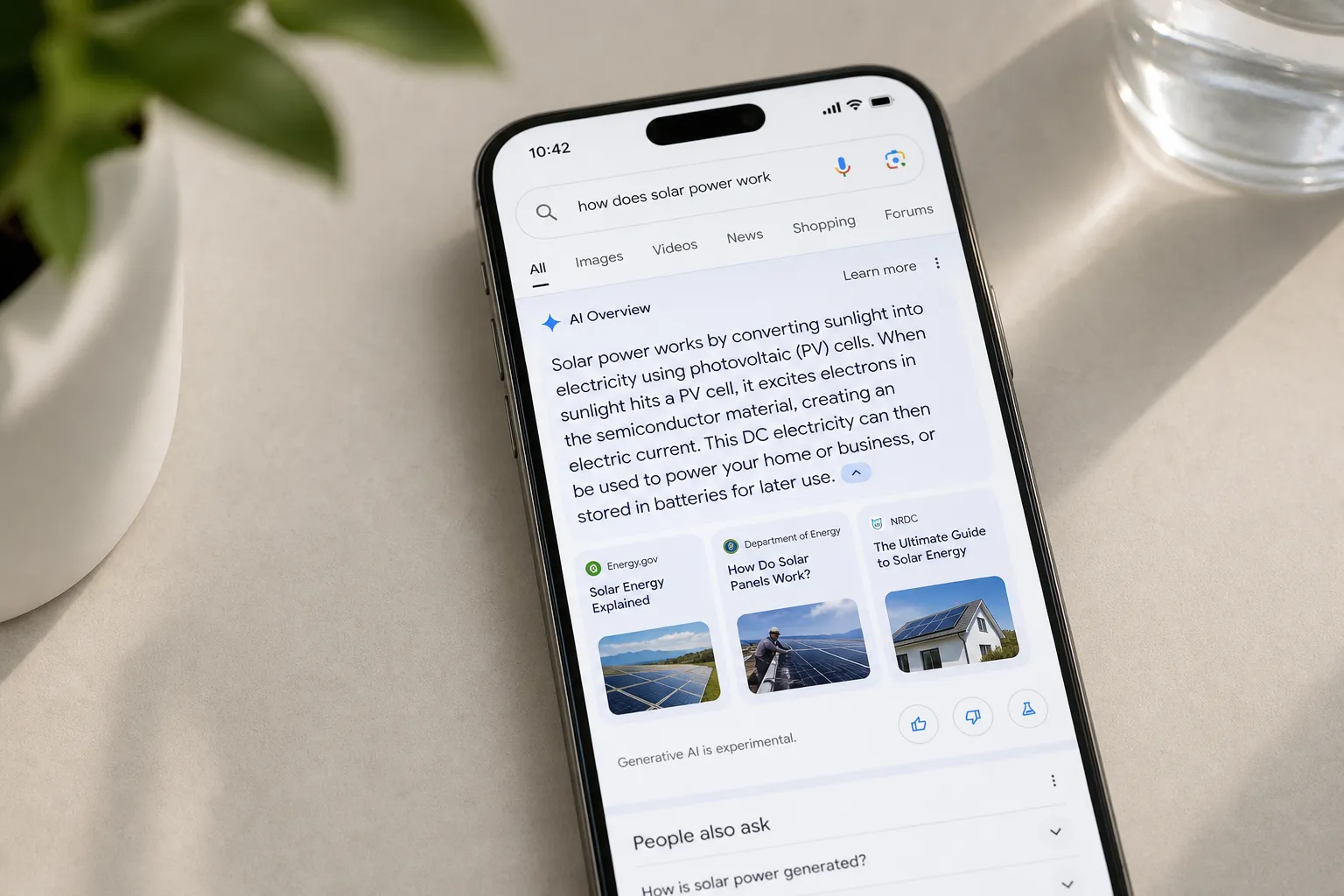
Search is shifting from ten blue links to AI answers. If your pages are not cited in those summaries, you are missing discovery at the exact moment users make choices. Use this guide to understand how AI answers pick sources and what to change so your site gets referenced more often.
How AI answers select citations
Generative engines assemble answers from pages they can trust and quote cleanly. Traditional ranking signals still matter, but AI adds a layer of safety and structure. Think in terms of what the model can verify, lift, and reuse without risk.
- Entity alignment: Pages that clearly represent recognized people, companies, products, places, and topics win. If the question is about "SaaS SEO pricing" and your page is a definitive pricing explainer from a SaaS-focused SEO service, you are a safer cite than a generic blog.
- Quotable structure: One-sentence definitions, numbered steps, and tight bullets reduce ambiguity. Models prefer a clean, sourceable unit over a paragraph that mixes claims, caveats, and anecdotes.
- Schema confirmation: Article and FAQ schema tell engines where concise answers live. Correct authorship, publish and modified dates, and clear headlines improve parsing and confidence.
- Consensus with a useful edge: AI favors claims that align with reputable sources but add a specific detail, example, or step the model can attribute.
- Freshness and consistency: Updated statements that match your title, headers, and meta reduce conflict signals. Outdated dates, contradictory numbers, or wobbly wording get skipped.
- Authority and crawlability: Contextual dofollow backlinks, solid internal links, and indexable pages get crawled and considered more often. If a page is hard to reach or not indexed, it will not be cited.
- Geo and intent match: Local answers cite local entities. If the query has a regional angle, engines prefer pages with matching place entities, addresses, and language variants.
Small sites can win. The common pattern behind outsized wins is simple: answer the question directly, label it clearly, back it with a couple of authoritative references, and keep your technical surface clean.
Make entities and schema unmistakable
AI systems index the world as entities and relationships. Your job is to make your brand, people, products, and topics unmissable and unambiguous.
Clarify your entities
- State the entity in the first 100 words: Example: "RankGoat is an SEO automation platform that writes blog posts, earns dofollow backlinks, and fixes crawl and indexing issues so your site ranks and appears in AI answers." Keep this description consistent across About, homepage, and profiles.
- Use consistent naming: Keep the same brand, product, and person names across titles, H1s, author bylines, and bios. Avoid nicknames and variations that muddy recognition.
- Map content clusters: Tie support posts to a revenue page with a clear topical theme. For a "Programmatic SEO" page, plan sub-entities like templates, internal linking, indexation troubleshooting, and measurement. Interlink all child posts back to the parent.
- Add real-world grounding: Include office locations, service areas, and industries served. Reference specific tools, data sources, or standards you follow to anchor your claims.
Implement supporting schema
- Article schema: Provide headline, description, author, datePublished, dateModified, and mainEntityOfPage. Match these to on-page elements to avoid conflicts.
- FAQ schema: Place 3–6 crisp Q&As on the page, then mark them up. Keep answers to 40–60 words to make them liftable. Only mark up content that is visible on the page.
- Organization and Person schema: For brands and authors, include name, logo, founding date, sameAs profiles, and jobTitle for authors. Consistent author entities support trust.
- LocalBusiness schema if relevant: Include address, geo coordinates, service area, and opening hours for location-sensitive topics.
RankGoat plans clusters around your revenue pages, writes the posts, and ships Article and FAQ schema, titles, meta, headers, alt text, and internal links so relevance is machine-readable from day one.
Content patterns that get cited
Format can double your inclusion rate without adding new ideas. Give the model clean, self-contained chunks it can quote.
Patterns to favor, with examples
- Definition + qualifier: Lead with a one-sentence definition, then add a short qualifier. Example: "Generative Engine Optimization is the practice of structuring pages so AI systems can verify, quote, and attribute your answers."
- 5–8 numbered steps: For how-tos, limit each step to one action and one detail. Example: "3) Add FAQ schema. Mark up 3–6 visible Q&As; keep answers under 60 words to improve liftability."
- Decision criteria lists: Summarize what to evaluate, not which brand to buy. Example: "Evaluate crawl budget impact, indexation risk, backlink context, and snippet clarity before picking an SEO tool."
- Data points with attributions: Provide a stat and cite your source on-page. Models prefer verifiable numbers over vibes.
- Mini-glossaries: A short list of related terms with one-line definitions increases entity coverage and provides ready-made quotes.
Quick wins you can ship this week
- Add a compact FAQ to your top five money pages. Write six questions you hear on sales calls, keep answers to 40–60 words, and mark them up.
- Rewrite the first 3–4 sentences of two cornerstone guides to include a definition and one concrete example. Remove filler like "in today’s world" that adds zero signal.
- Fix 20 orphaned posts by linking them from a category hub and adding one contextual link to a revenue page in the first 200 words.
- Localize your highest-converting guide into your second-most-visited language and add hreflang between versions to match non-English queries.
- Publish a comparison checklist with 7–9 criteria. Avoid brand names; models prefer reusable frameworks over sales pitches.
For a pattern you can mirror outside SEO, look at a clean example from the ai job search niche. This Automated Job Matching Guide to Cut Your Search Time in Half leads with definitions, breaks actions into short bullets, and uses direct, quotable language that models can lift.
RankGoat automates this workflow: it writes and auto-publishes helpful posts on a steady cadence, maps internal links, and keeps your structure scannable so your explanations get reused in AI answers.
Measure, fix, and grow inclusion
You cannot improve what you do not track. Treat AI visibility as a KPI and iterate weekly.
What to track
- Inclusion rate: From a set of target queries, log how many AI answers mention or link to your brand each week.
- Snippet ownership: Note which exact paragraphs, lists, or FAQ entries are quoted and from which URLs.
- Gap analysis: Find topics where rivals are cited but you have a related page. Diagnose whether the miss is entity clarity, structure, depth, or freshness.
- Geo coverage: For location or language variants, check whether localized pages are the ones being cited.
Fix crawl and index fundamentals
- Indexability first: Ensure priority pages are indexable and indexed. Address common issues like "Crawled, not indexed," "Discovered, not indexed," soft 404s, and duplicate without user-selected canonical.
- Sitemaps and robots: Validate XML sitemaps, ensure canonical versions are listed, and confirm robots.txt, meta robots, and x-robots headers are not blocking key pages.
- Render and speed: Confirm primary content renders without heavy client-side dependencies. Keep Core Web Vitals healthy so crawlers and users can parse content fast.
- Internal links: Give every post 2–3 relevant internal links in and out. Surface critical pages from hubs and nav; avoid deep, lonely URLs.
Build authority signals that stick
- Contextual dofollow backlinks: Favor in-article links from relevant pages with natural anchor text. RankGoat adds one vetted context link per post, monitors it daily, and replaces it if a partner drops or nofollows the placement.
- Anchors and placement: Use descriptive anchors that match the target’s topic. Mid-article links surrounded by supportive text tend to pass the strongest signals.
- Link consistency over spikes: A steady cadence of quality links beats sporadic bursts. It looks natural and keeps crawlers returning.
Iterate content with GEO tactics
- Tighten intros: Move definitions and key numbers to the top. Make your first 100 words quotable.
- Promote liftable blocks: Label checklists, steps, and criteria with clear H3s so models can isolate them.
- Refresh dates and data: Update modified dates when you add new numbers or steps. Remove stale lines that conflict with current guidance.
RankGoat tracks AI search visibility and applies GEO updates automatically. When content underperforms, it adjusts copy and structure, republishes within plan limits, and verifies indexation so improvements can be measured.
Key takeaways
- AI citations favor clear entities, quotable structure, and trustworthy links.
- Article, FAQ, Organization, and Person schema make relevance machine-readable.
- Measure inclusion weekly, identify the exact snippet patterns that win, and replicate them.
- Fix crawl, render, and index issues before chasing new keywords or links.
- Use automation for cadence and reliability. RankGoat writes posts, builds dofollow context links, and maintains technical hygiene in one workflow.
Teams that win AI citations ship tidy answers, keep a clean technical base, and iterate every week. Do those three and visibility follows.