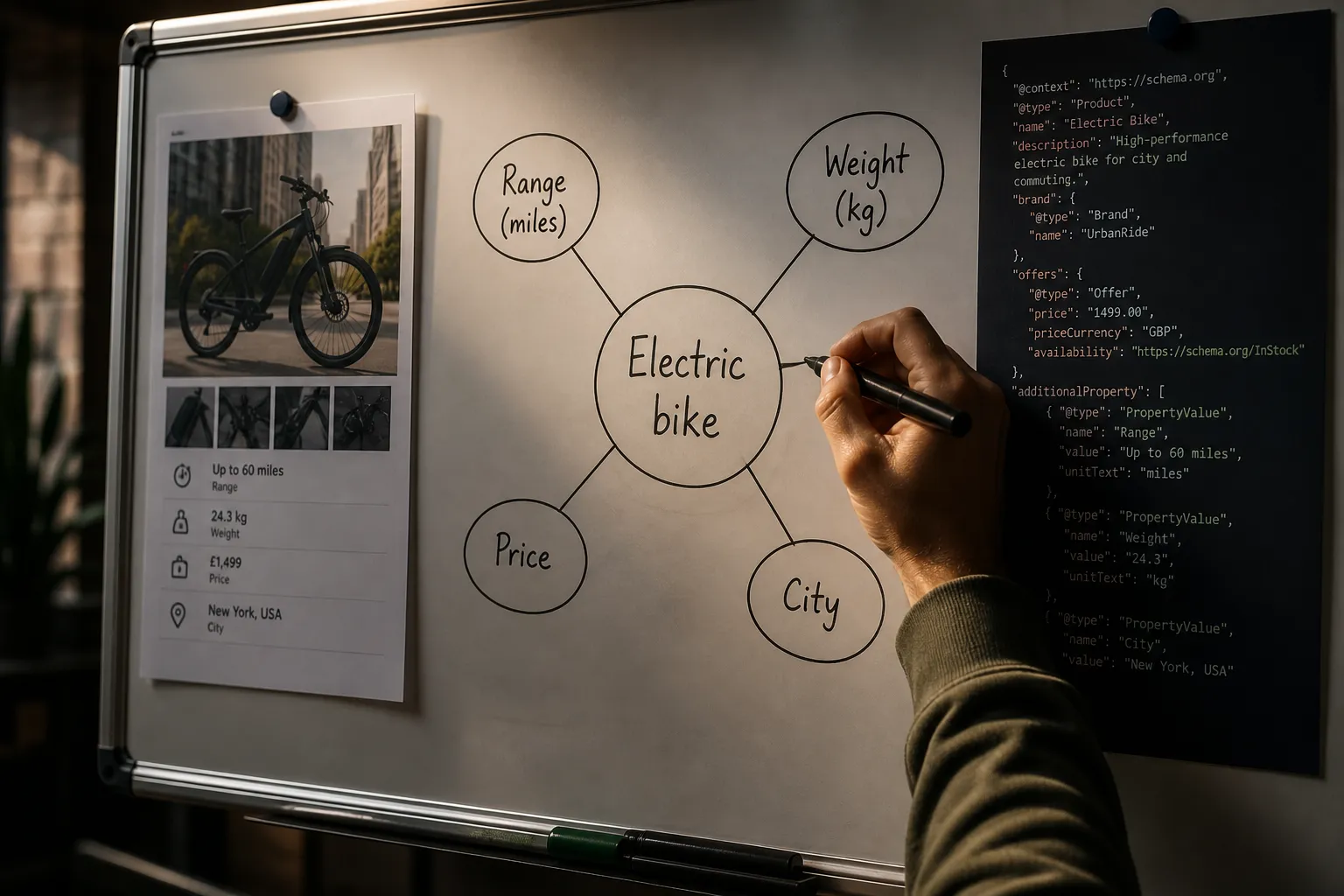
AI overviews and chat-style results now sit above the fold for countless searches. If you want your brand cited in those answers, your pages need to match how answer engines understand the world: as entities, attributes, and relationships. Get specific, structure for extraction, earn citations that stick, and keep the site clean and current.
Model entities the way answer engines think
AI systems map a question to entities and attributes, then lift statements that connect them. Make those connections obvious on the page.
- Identify the primary entity and its type. Is your page about a Product, Service, Person, Organization, Place, or Event? State that plainly in the first 1 - 2 sentences.
- List concrete attributes with units. For a product: dimensions, weight, materials, price, warranty, release date. For a local service: service area, hours, pricing model, certifications, typical response time.
- Use the names people search. Include common synonyms and model numbers. If a feature has multiple labels, mention them all once so disambiguation is easy.
- Relate entities. Connect a Person to an Organization, a Product to a Category, a Place to a Region. Use consistent names and avoid nicknames that create near-duplicates.
If you run a directory like TutorListed, make each tutor a Person with subjects, levels, city, and availability, then relate those tutors to local queries and outcomes. Put the city and subject in predictable places (title, H1, intro, table), and keep spelling and capitalization consistent. Add one short “At a glance” box that lists the top attributes answer engines would need to quote your page correctly.
Two practical tips make this work faster:
- Give important entities their own URLs. A tutor profile, a location page, and a category hub each deserve a stable page with canonical signals, not just a filter state.
- Use simple tables for specs and availability. Tables with labeled rows and standard units are easy for models to parse and hard to misread.
Structure pages and schema for extraction
Make it effortless to pull a correct, self-contained answer.
- Lead with the answer. Start with a 1 - 2 sentence summary that addresses the core query. Follow with detail, examples, and exceptions.
- Write scannable subheads. Use H2 for major questions and H3 for steps or sub-points. Turn searcher questions into headings where it makes sense.
- Add structured data that matches the visible copy. Use Article on editorial posts and FAQPage when you have clear question-and-answer pairs. Keep the text in schema in sync with the on-page text.
- Align fields to sections. For Article, map headline, description, author, datePublished, dateModified, and mainEntityOfPage to what readers see. For FAQPage, mirror each Q/A exactly.
- Show freshness. Display a “Last updated” date and a short changelog line when you update numbers, specs, or references.
With RankGoat, posts ship with on-page SEO and schema that include Article and FAQ markup, so the technical groundwork is handled while you focus on substance and clarity.
Citations and links that AI trusts
Answer engines prefer pages that cite claims and also earn citations from relevant sites.
- Cite primary sources when you state a fact, standard, or statistic. Use the exact entity names and titles found in those sources to reduce ambiguity.
- Write like an editor. Attribute quotes and figures in-prose near where they appear, not buried in a footer.
- Earn contextual dofollow links from pages about your topic. A link inside a paragraph that mentions your main entity sends a much stronger signal than a profile link or a random list.
- Keep your anchors natural. Vary phrasing, but keep the core entity name stable so models can connect mentions.
- Avoid reciprocal link swaps and irrelevant placements. They look like trading and do little for authority in the right neighborhood.
On the acquisition side, RankGoat can place network dofollow backlinks into contextual content on vetted member sites, and its daily link monitoring reroutes or replaces links if a partner drops or nofollows them. Pair those links with clear internal links from your related articles to guide crawlers toward the page you want cited.
Technical health, clusters, and localization
If a page is hard to crawl, unclear, or not indexed, it will not be quoted. Keep the plumbing tight, and organize content so authority flows to the pages that matter.
- Fix crawl and index blockers. Check Search Console weekly. Use URL Inspection to confirm the indexed URL, the selected canonical, and last crawl date. Resolve soft 404s, loops, broken canonicals, and parameter bloat.
- Publish a clean sitemap and keep it in sync. Only include canonical, indexable URLs. Remove test pages. Validate that the lastmod dates reflect real updates.
- Repair orphan pages. Every indexable page should have at least one crawlable path from your nav or hubs. Add links from relevant articles and category pages, not just from tags.
- Consolidate duplicates. Merge near-identical pages and redirect to a single canonical. Keep one primary URL format (trailing slash, lowercase, query parameters) across the site.
- Build topic clusters around revenue pages. Create a hub that defines the topic, then support it with posts that cover comparisons, pricing factors, how-tos, and troubleshooting. Link back to the hub with descriptive anchors.
- Localize when user intent is local or multi-language. Write native content for each market and connect versions with correct hreflang values (for example, en-us, en-gb, es-mx). Localize currency, addresses, measurements, and brand terms users actually type. Do not just translate.
RankGoat runs indexing checks and fixes and handles technical SEO cleanup, and you can spot issues yourself with free tools like its Sitemap Checker and SEO Checker. RankGoat’s topic and keyword planning clusters content around your revenue pages and ensures entity coverage is complete. Its multilingual localization detects your site’s language, writes natively, and publishes with correct hreflang tags.
Maintain freshness and monitor AI answer coverage
AI results lean on pages that are maintained and up to date. Make freshness visible and track where you show.
- Set a review cadence for evergreen guides. Quarterly, update prices, specs, examples, and screenshots. Note the change in a one-line changelog and bump the modified date.
- Add new subheads for rising related questions. Surface them in the intro with jump links so both users and crawlers find them quickly.
- Track AI visibility for your target queries. Watch which pages are cited and which entities the answer mentions. When coverage dips, compare your on-page entity list to what the answer quotes and add missing attributes or clarifications.
- Make this a weekly check-in, not a one-time project. Small, steady edits compound into stronger inclusion.
RankGoat’s AI search optimization tracks AI search visibility and applies Generative Engine Optimization alongside on-page tweaks that improve inclusion in those results. RankGoat’s automated blog publishing keeps a steady flow of helpful posts so your site does not go stale.
Key takeaways
- State the entity, its attributes, and relationships in plain language, with consistent names and units.
- Structure pages for extraction: lead with the answer, use clear H2/H3s, add Article and FAQ schema that mirrors visible copy.
- Back claims with citations and earn contextual dofollow links from relevant articles; avoid irrelevant or reciprocal swaps.
- Keep the site healthy: fix indexation and canonical issues, maintain a clean sitemap, repair orphans, and consolidate duplicates.
- Organize clusters around revenue pages, localize natively with correct hreflang, and keep content fresh while tracking AI answer coverage.
Showing up in AI answers is not a trick. It is the sum of specific entities, clear structure, credible citations, and steady upkeep. If you want help, RankGoat combines a done-for-you blog writing service, on-page SEO and schema, indexing checks and fixes, multilingual localization, and a backlink building service that is monitored daily. If you are weighing RankGoat pricing, pick the plan that matches your posting cadence, coverage goals, and languages, then let the workflow keep your site current.
FAQ
How do I make my page show up in AI answers?
Name the right entities, add Article and FAQ schema, cite sources, earn contextual links, and keep the page fresh. Then monitor AI answer coverage and fill entity gaps.
What is GEO in SEO?
GEO stands for Generative Engine Optimization. It means shaping content and structure so generative search systems can understand and cite your pages in their answers.
Does schema markup really help AI results?
Schema does not guarantee inclusion, but it clarifies your entities and question-answer pairs, which makes extraction easier. Use Article and FAQ schema where it fits.
How often should I update pages to keep AI visibility?
Review key pages monthly and update facts, numbers, and examples. Watch AI answer coverage weekly and edit when you see entity gaps or a drop in inclusion.
Do backlinks matter for AI-generated results?
Yes. Contextual dofollow links from relevant sites and solid internal linking help engines trust and discover your pages, which supports inclusion in AI answers.