AI overviews are now a front door to your site. If you want traffic, you want to be named as a source. Here are eight concrete moves that raise your odds of earning citations in AI answers without guesswork.
Build entity-driven clusters that feed your money pages
Move 1: Map entities and build supporting pages
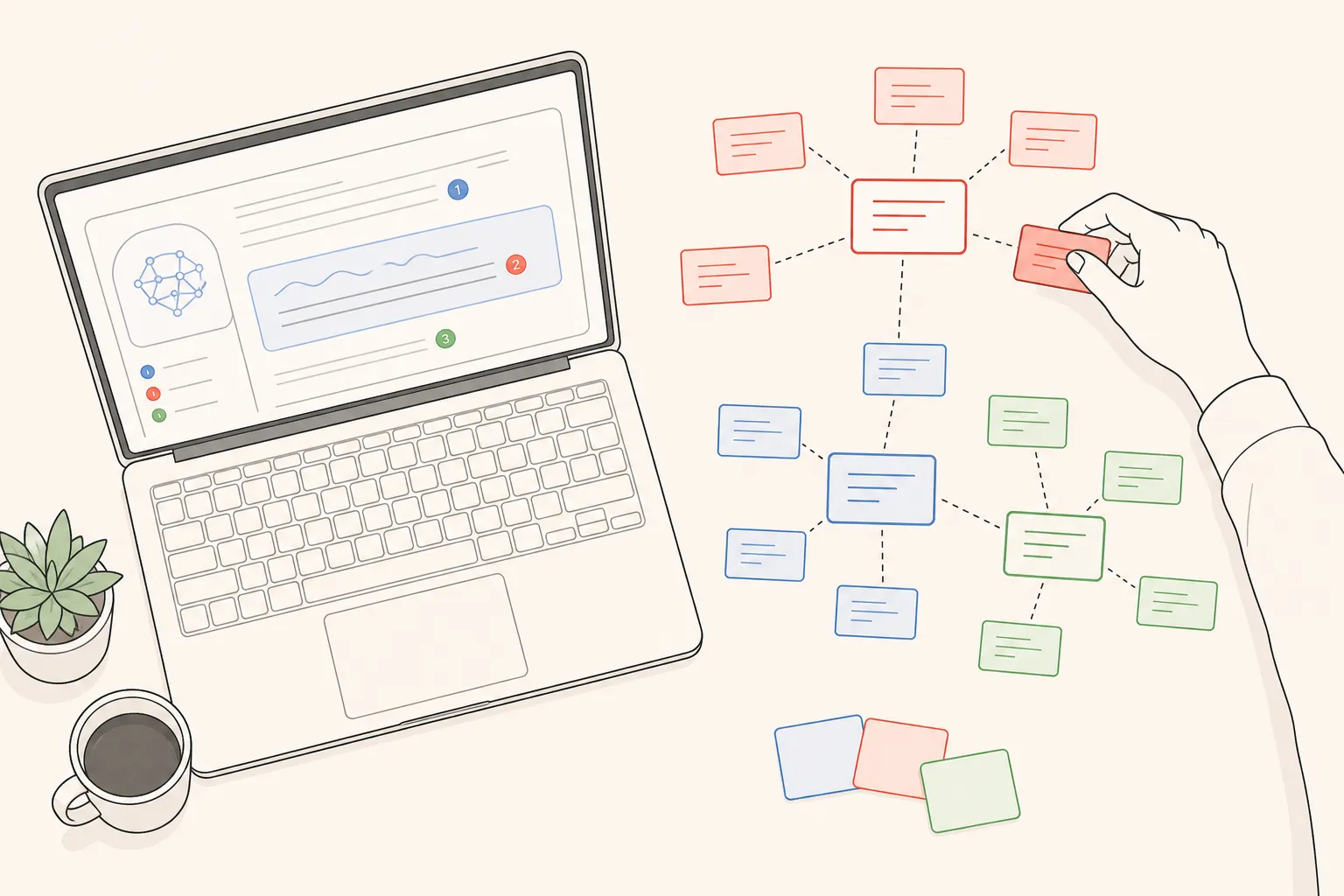
Models organize knowledge around entities, not loose keywords. Treat your topic as a graph. Start with the page that makes you money, list the entities it relies on, then create supporting pages that define and connect them.
Example: A “roof replacement in Austin” service page depends on entities like asphalt shingles, roof pitch, hail damage, permits, insurance claims, and Austin climate data. Create concise explainer posts for each, plus comparison pages like “asphalt vs metal roof in Texas heat” and Q&A posts such as “how long does an asphalt roof last in Austin.” Internally link from each support post back to the service page with clear, descriptive anchors. Do the same across sibling posts to form a tight cluster.
RankGoat plans clusters with mapped keywords, internal link paths, and entity coverage so every post strengthens the revenue page that needs to rank and get cited.
Make content quotable and machine readable
Move 2: Write for the question and the quote
Citations tend to be short, precise, and easy to lift. Lead with a 1 to 2 sentence summary that directly answers the query, then expand with steps or examples. Put the core entity in the first paragraph.
Pattern that works:
- First 1 to 2 sentences: the answer, including a number, timeframe, or condition if relevant. Example: “Most asphalt roofs in Austin last 15 to 25 years, depending on ventilation, shingle grade, and hail exposure.”
- Then a simple list of how it works or what to do next. Keep sentences short. Use the same terms searchers use in the heading and the first sentence.
- Avoid hedging and filler. If you have a unique process or data point, include it plainly.
RankGoat ships posts with tight titles, meta tags, headers, alt text, and internal links so your pages surface clean snippets models can quote.
Move 3: Add Article and FAQ schema the right way
Structured data helps models understand your page and the exact section that answers a question. Mark the page with Article schema that includes headline, datePublished, dateModified, author, and mainEntityOfPage. Add FAQPage schema only for Q&A that is actually on the page. Keep questions natural and answers concise.
Tips:
- Do not spam every page with FAQ if it adds no value. Two to five strong Q&A pairs beat a dozen weak ones.
- Match the question text in schema to the on-page heading and answer. Avoid paraphrase drift.
- Validate after publishing and after major edits.
RankGoat includes appropriate Article and FAQ schema on each post so your answers are machine readable from day one.
Strengthen authority models can verify
Move 4: Cite credible sources and earn them back
Back up claims with reputable primary sources like standards bodies, government datasets, or named organizations. Reference exact figures and names so your statements are traceable. Then build your own credibility with clean, contextual links pointing in.
What helps:
- Use in-prose citations to original studies or standards when you cite a number or a rule.
- Avoid linking to thin roundups. Choose the origin of the data when possible.
- Earn links from pages that mention your topic, not random directories. Context matters.
RankGoat secures a non-reciprocal, contextual dofollow link to each post from a vetted member site and monitors daily to replace or reroute if a partner drops or nofollows your link. You get authority without babysitting.
Move 5: Improve E-E-A-T signals where they are checked first
Show experience with first-hand steps, data you collected, or examples from your work. Add an author bio with credentials, a date, and an editorial process note if you have one. Keep sitewide basics solid: About, Contact, privacy, and clear navigation. Use consistent bylines and headshots so authorship is easy to resolve.
RankGoat publishes helpful posts on a steady cadence and ties them back to your key pages, which supports perceived expertise over time.
Ship the technical basics and win across regions
Move 6: Fix indexing and technical tripwires
If a crawler struggles to fetch or trust your page, an AI model will too. Audit and fix:
- Orphan pages: add internal links from relevant posts and hubs.
- Soft 404s and thin duplicates: consolidate with canonicals or redirects.
- Query parameters and odd pagination that hide content: standardize URLs and use rel=canonical where needed.
- Sitemaps and robots: include only canonical URLs, keep sitemaps under size limits, and avoid accidental disallows.
- Core Web Vitals and rendering issues that block content from loading or being indexed.
Check indexation weekly. Use server logs to spot crawl traps, Search Console to review crawl stats and indexing, and the site: operator to catch anomalies.
RankGoat handles technical SEO cleanup, indexing checks and fixes, and offers free tools like a Domain Rating Checker, SEO Checker, Sitemap Checker, and SERP Snippet Preview so you can spot and resolve issues fast.
Move 7: Localize language and signals for how people search
AI answers often match the searcher’s language and region. If you sell in multiple markets, publish native language versions and wire them with proper hreflang. Keep examples, pricing, measurements, and terminology local.
Guidelines that prevent headaches:
- Use hreflang pairs like en-us, en-gb, es-mx, and include self-references on each version.
- Point regional variants to regional contact details, currency, and units. Do not just translate words.
- Avoid mixing multiple regions on one page. Give each its own URL.
RankGoat detects your site’s language, writes natively, and localizes posts into selected languages with hreflang linking. That supports GEO coverage and broader AI answer eligibility across regions.
Move 8: Measure AI answer inclusion and tune topics
Track the queries where your brand or pages appear in AI answers and note what text gets pulled. Start a simple sheet with query, page, snippet copied verbatim, section heading, and position on the page. Compare pages that win citations to those that do not.
Then tune:
- Rewrite the first 2 sentences to answer the query plainly if they are vague.
- Align headings with the phrasing searchers use. If people ask “how long,” do not title it “duration considerations.”
- Add an internal link from each support post to the hub with the most direct anchor you can write.
- Fill entity gaps you keep seeing in cited snippets, like missing definitions or key steps.
RankGoat tracks AI search visibility and applies Generative Engine Optimization alongside on-page tweaks, schema, and entity coverage, then auto publishes new posts up to plan limits.
Key takeaways
- Plan clusters around entities and revenue pages, not one offs.
- Lead with a quotable 1 to 2 sentence answer, then expand.
- Add Article and FAQ schema that mirrors on page content.
- Earn contextual dofollow links and show real authorship.
- Fix indexing, localize correctly, and track AI citations to iterate.
AI citations go to clear answers on technically sound pages that sit inside a well linked cluster. Focus on entities, structure your responses, prove credibility, and keep shipping. If you want this running without adding headcount, RankGoat pairs automated blog publishing with a network dofollow backlink on every post, ongoing GEO adjustments, and technical fixes so you can move from experiments to steady gains.
FAQ
What is AI search visibility?
AI search visibility is how often and where your pages are cited or referenced inside AI-generated answers on search platforms.
How can I tell if my site is cited in AI answers?
Check your priority queries in search and note the sources in the AI panel, then track appearances over time to spot patterns and gaps.
Does adding FAQ schema help with AI Overviews?
Yes. Clear FAQ schema makes your concise Q&A machine-readable, which can improve how models extract and attribute answers.
How many backlinks do I need to earn AI citations?
Quality and context matter more than a number. A steady flow of relevant, dofollow links to the right pages will help more than volume alone.
What is GEO in SEO?
GEO stands for Generative Engine Optimization. It is the practice of shaping content and site signals to earn inclusion in AI-generated answers.