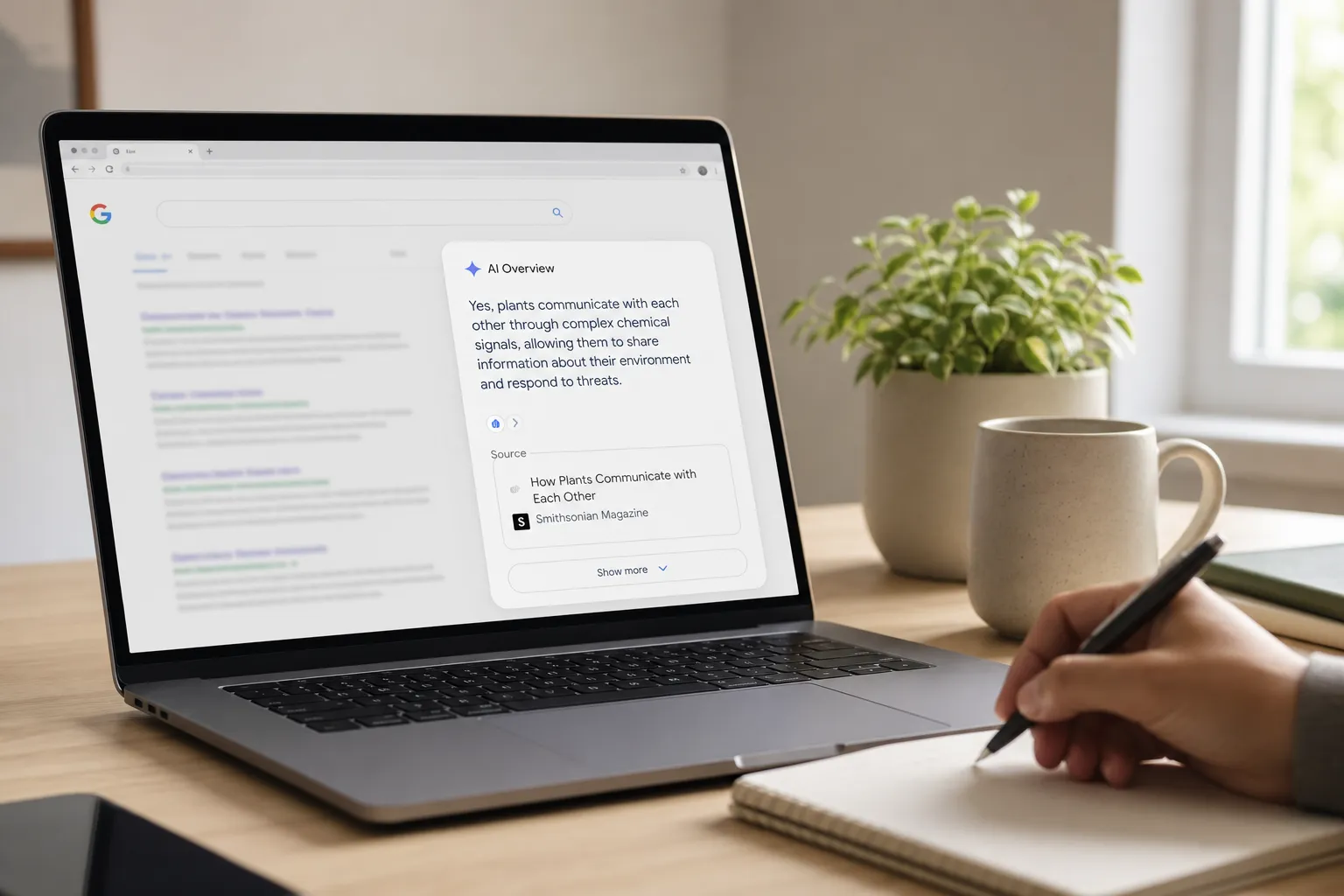
AI Overviews and chat-style results are absorbing search attention. If your page is not the cited source, you lose visibility and trust. Getting cited is not luck. You can design content that answers clearly, proves expertise, and earns the links AI systems rely on. Here is a practical plan that you can run every month.
Pick answerable queries with clear citation intent
Start where AI wants a short, sourced answer. You are looking for intents that benefit from a concise explanation, a checklist, a data point, or a step-by-step.
Query patterns that work
- Definitions and distinctions: “what is canonicalization,” “E-E-A-T vs E-A-T.”
- Comparisons and thresholds: “CDN vs edge cache,” “Core Web Vitals pass rates for ecommerce.”
- Procedures and checklists: “how to generate a product feed in Shopify,” “on-page SEO checklist 2026.”
- Costs and timelines: “roof replacement cost in Austin 2026,” “lead time for custom cabinets.”
- Local outcomes: “best time to aerate lawn in Dublin,” “emergency plumber response time in Cork.”
How to find them quickly
- Mine your sales and support logs. Pull the last 200 questions prospects asked. Sort by frequency and sales impact.
- Scan live SERPs. If you see AI Overviews, large People Also Ask boxes, or a heavy snippet presence, the query is primed for a cited summary.
- Add GEO modifiers. Mirror service areas in copy, headings, and schema. Build one pillar page per service and city, then support with narrower posts.
- Validate with a gap check. Open the top three results. Note what is missing: current-year data, local specifics, clear steps, or screenshots. That gap is your angle.
RankGoat plans clusters around these query patterns. We map the pillar, assign supporting posts, and schedule refreshes so your answers stay current and citeable.
Make your pages citeable and machine-readable
A page gets cited when it is unmistakably the source. That means concrete detail for humans and unambiguous markup for machines.
On-page structure that wins citations
- Lead with a one-sentence definition or TL;DR. Follow with a numbered process or checklist that a model can quote verbatim.
- Add original elements: proprietary numbers, before-and-after screenshots, photos of your work, or a small table of benchmarks. Call out exact thresholds and timelines.
- Show your method. Add a short methodology and a sources list at the end. State your sample size, timeframe, and tools.
- Prove authorship. Include the author’s name, title, 1–2 lines of credentials, and visible datePublished and dateModified.
Schema and metadata to remove ambiguity
- Organization with legal name, logo, sameAs profiles, contact page, founding date, and address. Add geo coordinates if local intent matters.
- Person for each author with name, job title, areas of expertise, and sameAs links. Associate every article with its author.
- Article or BlogPosting on every post with headline, description, mainEntityOfPage, datePublished, dateModified, author, and publisher. Reference citations in-body, not only in schema.
- FAQPage or HowTo only when the content truly matches. Include steps, tools, supplies, and totalTime for HowTo.
- LocalBusiness if you serve a region. Keep NAP consistent across schema, footer, and listings. Include serviceArea for coverage.
- Dataset for proprietary stats, surveys, or benchmarks with name, description, variableMeasured, creator, and dateCreated. Models love primary data.
Technical details that prevent citation loss
- One canonical URL per page. Noindex thin or duplicate variants. Do not block CSS or JS in robots.txt.
- Stable anchors and heading hierarchy. If you want a section cited, make it a clean H2 or H3 with a persistent ID.
- Open Graph and Twitter meta for consistent titles and images. Use descriptive, truthful alt text on images.
- XML sitemaps with lastmod. Fix 404s and redirect chains. Keep CLS, LCP, and TBT within pass ranges to avoid crawling and rendering hiccups.
If your site foundation needs work, partnering with a reputable website design company can help. A web design and development agency that builds and optimizes business websites and e-commerce stores, with SEO and related services, can tighten performance, accessibility, and on-page structure so your expertise is easy for machines to parse.
RankGoat bakes schema, author profiles, and internal links into every post. That consistency compounds E-E-A-T signals and makes it easy for AI systems to choose your page as the source.
Earn citations and relevant dofollow links
Off-site signals confirm authority. Focus on context-rich, editorial links that live on pages humans actually read.
Plays you can run every month
- Journalist responses. Track reporter requests in your niche. Reply with a quotable 2–4 sentence answer, one stat, and a link to your source page. Include your full name, title, headshot, and a 75-word bio. A weekly cadence of 10 pitches can land 1–3 placements once your answers are tight.
- Resource page outreach. Find university, association, or government resource hubs via operators like site:.edu intitle:resources KEYWORD and inurl:links KEYWORD. Pitch your definitive guide that fills a gap and include a 40–60 word description they can paste in.
- Guest insights, not guest posts. Offer a specialized section inside an in-depth partner guide. Make your contribution data-heavy and link contextually from the body to your source page.
- Quarterly data drops. Publish a small dataset or trend summary with clear methodology. Provide a downloadable CSV and a short narrative. Alert niche newsletters, community moderators, and analysts who curate stats.
- Update-and-credit. Search for posts using last-year data. Email the author with a current number on your site and a prewritten update that credits you as the source.
Make links support the right pages
- Deep link to the section that holds the fact or process you want cited. Use stable anchors so both links and models land on the exact snippet.
- Stack internal links from adjacent posts back to your pillar. Use descriptive anchors that match the question intent.
RankGoat pursues relevant editorial placements and routes link equity to your target pages. We prioritize pages that already rank or attract referrals so your citations echo into AI answers.
Measure AI visibility and iterate
You cannot optimize what you do not measure. Track where you get cited, which snippets win, and why.
Build a lightweight tracking system
- Maintain a spreadsheet of target queries with columns for engine, month, citation yes/no, snippet text, cited URL, and competing sources. Test monthly in Google, Bing, and leading assistants.
- Use Search Console patterns. Watch impressions for long-tail questions, Discover spikes tied to data posts, and site links on definition or comparison queries.
- Audit referrals. Note links that send engaged traffic or conversions. If a referring page ranks for your target query, that link is more likely to surface in AI answers.
- Refresh on a set cadence. Revisit money, safety, and stats-heavy posts every 90 days. Update figures, screenshots, and examples. Revalidate schema after edits.
Make deliberate experiments
- Rewrite your TL;DR to include the exact term and a concrete number or threshold.
- Promote a frequently cited paragraph to an H2 with a direct question as the heading.
- Spin off a Dataset page for a stat that earns links, then reference it from the article.
RankGoat reports on rankings, links, and AI citation wins, then proposes the next posts and refreshes to strengthen the cluster. You get steady visibility without juggling vendors.
Key takeaways
- Target questions that invite short, sourced answers, including local variants, and plan clusters around them.
- Make pages citeable: clear TL;DR, original data, visible authorship, and precise schema for Organization, Person, and Article.
- Earn editorial, in-body dofollow links that point to the exact section you want quoted.
- Track citations across AI experiences, watch GSC patterns, and refresh high-impact posts on a 90-day cycle.
- Systematize the process. The combo of structured content, relevant links, and regular updates is what AI systems reward.