Publishing a page and seeing Discovered, currently not indexed or Crawled, currently not indexed in Search Console is a gut punch. If crawlers hit blockers or your signals conflict, even great content sits invisible.
Use this checklist to find and fix indexing issues fast. Run it after launches, during migrations, and any time coverage drops. Most fixes take minutes and can save weeks of waiting.
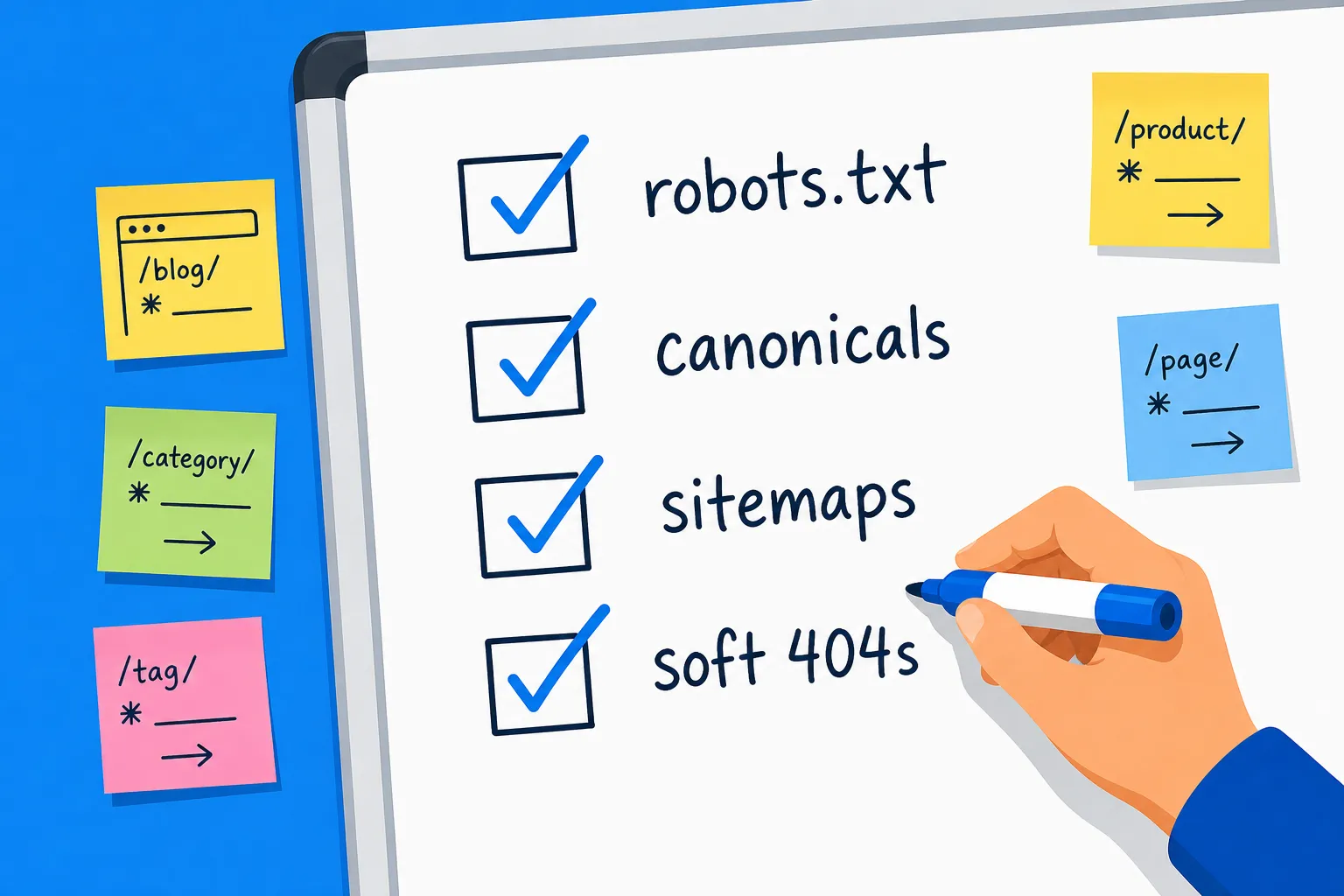
The indexing issues checklist
- Verify robots.txt, meta robots, and HTTP headers. Accidental noindex or blocked paths cause instant invisibility, so confirm you are not telling crawlers to stay out.
- Fetch your live robots.txt and confirm important sections are not disallowed. Keep staging or admin blocked, not live content. Example safe blocks:
Disallow: /wp-admin/andDisallow: /*?session=. Avoid blanket rules likeDisallow: /on production. - View source for
<meta name="robots" content="index,follow">on indexable pages. Watch for template bugs that shipnoindexsitewide. - Check server headers with
curl -I https://example.com/page/. RemoveX-Robots-Tag: noindexandnofollowfrom HTML, media, or PDFs you want indexed. If you purposely noindex certain files, be consistent.
- Fetch your live robots.txt and confirm important sections are not disallowed. Keep staging or admin blocked, not live content. Example safe blocks:
- Confirm canonical URLs are correct and consistent. A wrong rel=canonical tells Google to index a different page, which can sideline the one you care about.
- Each indexable URL should have a single self-referencing canonical unless you are intentionally consolidating to a master version.
- Avoid conflicts. If a page 301s to
/blue-widgets/do not set a canonical to/widgets-blue/. Redirect target, canonical tag, and sitemap entry must all agree. - Standardize protocol, host, and trailing slash. Pick
https,wwwor not, and slash or no slash. 301 all variants to one preferred URL. Treat/Pageand/pageas separate on case-sensitive hosts.
- Audit hreflang and language signals. Bad hreflang can swap or suppress your page in the wrong locale, which looks like an indexing issue from your market’s view.
- Return 200 on every hreflang target. If a target 404s or 301s, that language pair is ignored.
- Reciprocal linking is required. Each variant must reference the others. Include
x-defaultfor a selector or global page when used. - Match language-region codes to content, for example
en-USvsen-GB. Do not point multiple languages at the same English page unless it truly serves both.
- Validate XML sitemaps and what they list. Sitemaps guide discovery. If they list non-indexable URLs, Google wastes crawl budget and trusts them less.
- Include only canonical 200 URLs. Remove
noindex, 3xx, 4xx, 5xx, and parameter-heavy pages that are not meant to index. - Keep
<lastmod>accurate using real content change times in ISO format. Do not bump it on every deployment. - Split large sitemaps under 50,000 URLs or 50 MB. Use a sitemap index and submit the index in Search Console.
- Include only canonical 200 URLs. Remove
- Control URL parameters and faceted navigation. Infinite combinations from filters or sorts can explode crawl paths and bury your core pages.
- Prefer clean URLs for primary pages, like
/shoes/womens/. Use parameters only when the content meaningfully changes, like?color=blackwith a distinct collection. - Block known trap patterns in robots.txt if they should never be crawled. Examples:
Disallow: /*?sort=,Disallow: /*?view=,Disallow: /*&page=9999. Do not block valuable parameter pages you actually want indexed. - Keep ephemeral parameters off internal links. If a parameter only changes layout or order, canonical to the clean version and avoid linking to it from key templates.
- Prefer clean URLs for primary pages, like
- Resolve duplicates and near-duplicates. If many pages say the same thing, Google may index only one or none of them well.
- Pick one URL per topic and 301 the rest. Merge thin tag or filter pages into stronger hubs with real copy, images, and internal links.
- Deduplicate print pages,
httpvshttps,/vs/index.html, and URLs with tracking params like?utm_source=. - Write unique titles and meta descriptions that reflect the page’s unique angle. This helps crawlers choose the right canonical.
- Fix soft 404s and thin templates. Empty or boilerplate pages trigger soft 404 signals that drag down trust and waste crawl budget.
- Return a real 404 or 410 for dead pages instead of serving a near-empty 200. Include a helpful not-found template with links to top categories.
- Do not publish empty category, profile, or city pages. Add content and listings, or noindex them until they meet a quality bar.
- Handle out-of-stock or expired items with clear alternatives, availability messaging, and structured internal links rather than blank shells.
- Stabilize rendering so content loads without fragile JavaScript. If key content relies on client-side rendering that fails or delays, crawlers may index a partial page.
- Render primary text, headings, and links in the initial HTML where possible. Defer non-essential scripts.
- Do not block required CSS or JS in robots.txt. If a resource is needed to render content or layout, it must be crawlable.
- Use URL Inspection to view rendered HTML and screenshots. Compare server HTML to rendered HTML. If they diverge, add server-side rendering or pre-render critical sections.
- Clean up crawl traps and infinite calendars. Loops from date pickers, user IDs, or endless pagination can burn crawl budget and hide your good pages.
- Avoid linking to empty next-month or previous-year calendar pages that repeat forever. Cap ranges and noindex utility pages that are not useful search results.
- Limit crawlable links that add only presentation, like
?view=gridand?view=list. If they exist, keep them out of main nav and canonical them to the base URL. - Watch server logs for repeated crawling of patterns like
?page=2&page=3or tokenized URLs. Patch at the app level.
- Implement sane pagination on lists and categories. Poor pagination can split signals or create duplicates that never consolidate.
- Let each page in a series canonical to itself. Do not canonical all pages to page 1.
- Give each page unique titles and H1s, for example “Women’s Boots, Page 2.” Keep intro copy unique or trimmed on deeper pages to reduce duplication.
- Link strongly between pages with clear prev, next, and numbered links. Offer a view-all only if it loads fast and is truly indexable.
- Re-submit and monitor coverage in Search Console. After fixes, you need a feedback loop to confirm Google sees the change.
- Use URL Inspection on a sample of high-priority pages. Click Test live URL, then Request Indexing for a limited batch.
- Watch Page indexing and Sitemaps reports. Key statuses to shrink: Duplicate without user-selected canonical, Soft 404, Alternate page with proper canonical tag, Crawled currently not indexed, and Blocked by robots.txt.
- Track for 1 to 2 weeks. If coverage does not improve, re-check for conflicting directives, 5xx spikes, or 429 rate limiting under load.
What good looks like in Search Console
Healthy sites keep a small gap between submitted and indexed URLs in sitemap-driven sections. Expect a handful of exclusions for utilities like cart and login. Soft 404s should trend toward zero. Duplicate without user-selected canonical should shrink as canonicals and redirects align. Sitemaps show a steady count and realistic lastmod. When you add new pages, Discovery and Crawled statuses turn to Indexed in days, not months.
If you run a directory or marketplace with lots of facets and cities, like SitterListed, watch your template quality and parameters. These sites benefit the most from clear canonical rules, strong internal link paths, and cautious publication of empty location or category pages.
When to automate and scale fixes
Indexing issues are not one-and-done. They creep back during deployments, content pushes, and theme changes. This is where an SEO automation tool that keeps you honest pays off. RankGoat performs weekly indexation checks, validates sitemaps and canonicals, and fixes soft 404s and duplicate content so problem pages do not pile up. The service also writes and auto-publishes helpful posts on a cadence, which creates fresh internal links that help discovery. Its network dofollow backlinks and daily link monitoring support ongoing crawl and ranking, while topic planning and on-page SEO with schema reduce duplication and clarify intent. If you target more than one language, multilingual localization with hreflang linking keeps variants indexable across regions. For AI search visibility, RankGoat tunes on-page signals to improve inclusion in AI answers. If you are weighing the cost of ongoing checks against lost traffic, compare that to RankGoat pricing and the hours your team spends chasing regressions.
How to run this checklist on a schedule
Before publishing
- Test a staging URL for robots, canonicals, rendering, and hreflang. Fix template-level faults before they multiply.
- Generate sitemaps from the canonical set only. Submit to Search Console on launch day.
Weekly
- Scan Coverage trends and investigate any spikes in Excluded statuses.
- Crawl key sections to catch new soft 404s, parameter leaks, or pagination errors.
Monthly
- Review duplicates and prune thin pages that slipped in through tags or filters.
- Spot-check rendered HTML on top revenue pages and templates after code changes.
If you handle this in-house, block regular time and document each run. If you prefer a done-for-you blog writing service and backlink building service bundled with ongoing technical checks, an automated option can keep the checklist running while your team ships product.
Key takeaways
- Most indexing issues trace back to mixed signals. Align robots, canonicals, hreflang, and sitemaps.
- Kill crawl traps from parameters, infinite calendars, and weak pagination.
- Soft 404s and thin templates waste crawl budget. Either enrich them or return real 404s.
- Validate fixes by re-submitting key URLs and watching Coverage over 1 to 2 weeks.
- Automate weekly index checks and on-page tuning to prevent regressions, and use AI-focused optimizations to help with answer inclusion.
Search engines reward clarity. Keep your signals clean and your pages will get crawled, rendered, and found.
FAQ
How long does it take for indexing issues to resolve after fixes?
Simple fixes can reflect in a few days. Larger template or duplication changes may take 1 to 2 weeks to show clear improvements in Search Console.
Should I block parameter URLs or canonical them?
If a parameter does not change the main content, canonical to the clean URL. If it creates infinite combinations or non-content pages, block it from crawling.
Is it okay to canonical all paginated pages to page 1?
No. Each page in a series should canonical to itself. Use clear titles and internal links so crawlers understand the sequence.
Do I need JavaScript rendering for indexing?
You can rank with client-side rendering, but ensure core content and links are accessible. Server-render key elements when possible and avoid blocking required resources.
Can backlinks help with indexing as well as ranking?
Yes. Quality links can improve discovery and crawl frequency by signaling importance, which often helps new pages get indexed faster.