You want search and AI visibility to grow every month without herding tools and freelancers. The real choice is not robots vs humans. It is which parts you should automate for speed and consistency, and which parts deserve human judgment. Here is a clear plan, with costs, examples, and a workable hybrid you can run next week.
Automated SEO vs manual: the quick view
| Aspect | Automated SEO | Manual SEO | Typical monthly cost |
|---|---|---|---|
| Content production | Programmatic briefs and first drafts using intent, entity, and SERP gap analysis. Scales to 20–60 posts per month. | Writer-by-writer research and drafting. High control, slower throughput. | Automation or service from low hundreds to low thousands |
| Backlink acquisition | Templated prospecting and outreach with vetted, dofollow placements on schedule. | Manual prospecting, cold emails, and negotiation. High time cost, inconsistent cadence. | Often bundled with automation. Manual can spike per-link costs |
| Technical SEO | Continuous crawling, indexing fixes, and site health tasks shipped weekly. | Quarterly audits, tickets, and backlogs. Fixes batch up and slow down. | Included in platform or billed via consultant retainers |
| AI search visibility | Structured, entity-rich content and schema tuned for AI answers and GEO. | Manual schema and entity work if remembered. Inconsistent coverage. | Included in modern automation. Manual requires specialist hours |
| Time to leverage | Days to launch, weeks to compounding output. | Weeks to hire and brief, months to hit stride. | Time is your hidden cost |
What to automate
Automate any repeatable task where rules beat vibes. Your goal is a consistent pipeline that removes handoffs without flattening your voice.
Content research and drafting
- Topic discovery that clusters keywords by intent and stage. Use entity coverage to avoid thin variants and to plan series, not one-offs.
- Briefs with working titles, H2s, internal link targets, FAQs, primary and related entities, and required examples. A good brief cuts drafting time in half.
- First drafts that clear a quality floor. Humans layer brand stories, screenshots, and examples in a short review loop. A done-for-you blog writing service should hand you publish‑ready drafts for most posts.
On-page optimization
- Programmatic internal linking using rules like hub to spoke, spoke to hub, sibling to sibling within a cluster, plus fresh-to-authority linking for faster discovery.
- Schema and entity markup at scale. Cover Organization, Article, FAQPage where relevant, Product or Service on money pages, and HowTo or QAPage where helpful. This supports AI answers and GEO (Generative Engine Optimization).
- Title and meta testing within safe character bounds, with variants that match intent and improve CTR without clickbait.
Backlink outreach at scale
- Prospect discovery and qualification with filters for domain quality, topical match, outbound link patterns, and traffic trends. Drop sites with spam footprints.
- Templated but personalized outreach that proposes value, not just a link ask. Track acceptance rate by niche and template.
- Placement tracking with anchor text balance rules and velocity smoothing so authority rises without tripping filters.
Technical hygiene
- Index management with sitemap freshness checks, log-like crawl signal reviews, and soft 404 sweeps. Auto-escalate true 404s and server errors.
- Continuous fixes for canonicals, robots directives, pagination, hreflang where relevant, image compression, and CSS or JS bloat reduction.
- Publishing automation that validates template health, injects schema, sets internal links, and ships on a schedule.
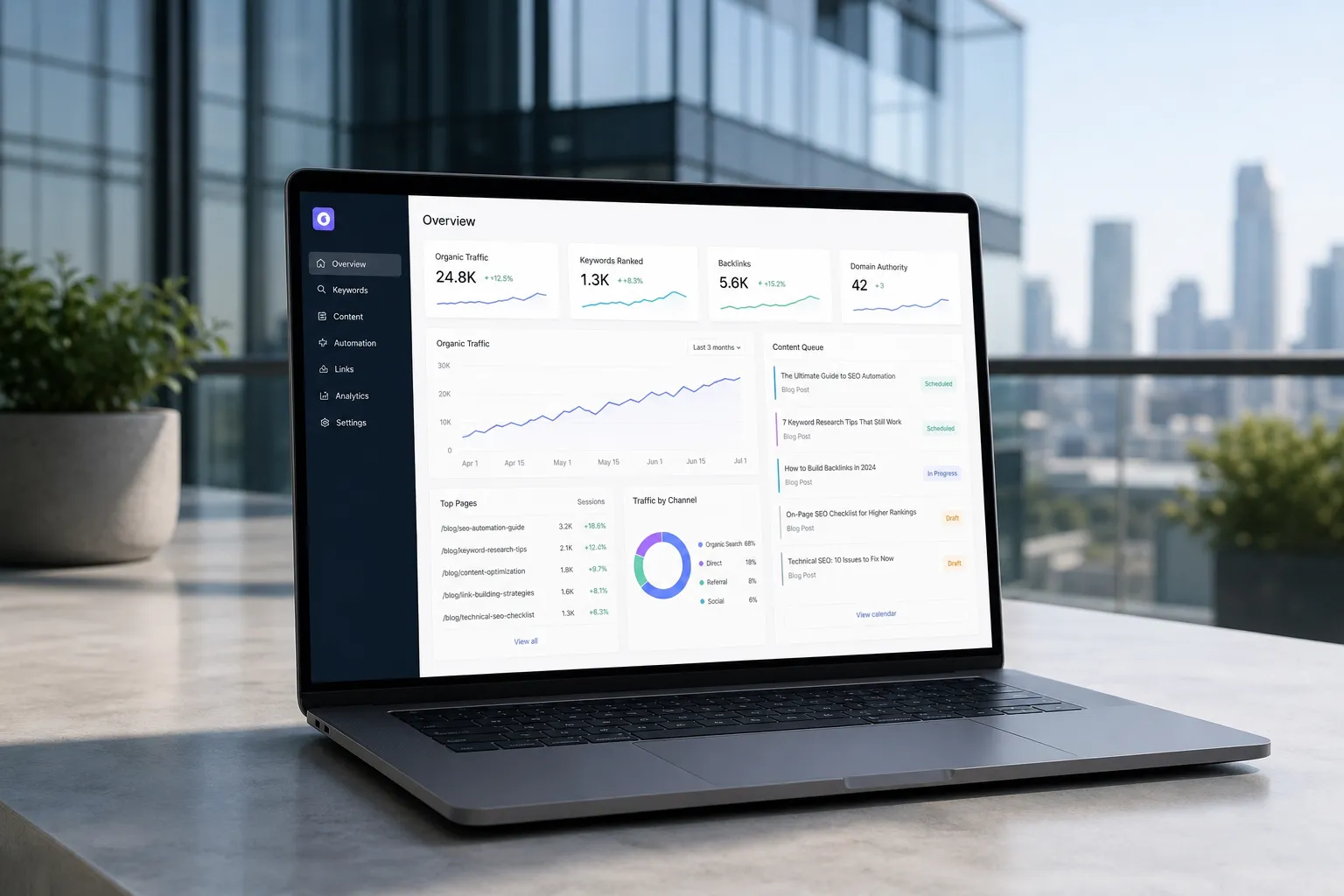
RankGoat automates this end to end. You get articles researched, written, and published, dofollow links secured on a predictable cadence, and indexing plus technical issues fixed without opening ten tabs. Most clients review drafts, approve links, then watch traffic and AI visibility compound.
What to keep manual
Use people where judgment, taste, and proprietary knowledge change outcomes.
- Brand voice and story. Add founder perspective, customer language, and examples only you can tell. A quick pass can turn a good draft into a remembered one.
- Subject matter expertise. Layer unique data, screenshots, product context, and field notes. This strengthens E‑E‑A‑T and improves how AI summaries cite you.
- High‑stakes pages. Hand‑edit home, pricing, product, comparison, and the top 10 percent of posts that drive revenue or links.
- Legal, medical, or compliance review. Keep this manual and documented with clear acceptance criteria.
- Local nuance. For geo pages, add neighborhood details, staff bios, real photos, and service boundaries that reflect how customers search.
Simple rule. Let the system handle volume. You handle taste.
Cost, time, and ROI math
Manual stacks often hide coordination costs. You pay for switching, meetings, and project drift as much as you pay for craft.
Typical manual stack
- SEO strategist part time for research and planning.
- One to two writers for 8 to 12 articles per month.
- Editor for QA and brand alignment.
- Outreach specialist for links.
- Developer time for technical fixes and publishing.
That team can produce excellent work, but it often runs into the mid four figures per month before compounding gains show. Hiring, briefing, editing, and managing outreach can absorb 20 to 40 hours monthly.
Automation and done‑for‑you
- An SEO automation platform replaces repetitive research, internal link building, and publishing.
- A done‑for‑you blog writing service removes briefing, drafting, and copyediting for most posts.
- A bundled backlink service delivers vetted, dofollow placements on a set cadence.
RankGoat bundles content, links, and technical into one plan. You do not stitch five vendors together, which is where budgets and timelines go sideways. If your time is worth real money, the saved hours alone can be your ROI.
The break‑even thought experiment
- Assume an article matures to 100 qualified visits a month. At a 2 percent conversion rate and $200 average order value, that is $400 per article per month.
- Publish 10 posts a month and you add roughly $4,000 in monthly revenue after ramp, before lifetime value and cross‑page lift.
- Steady dofollow links raise the whole domain, so later posts index and rank faster. That reduces payback time.
Results vary by niche and offer, but automation compresses time to output and smooths variance. Manual can land standout hero pieces. Automation wins on consistency and cadence, which is what compounds.
How to run a hybrid that wins
Blend automation for scale with human touch for differentiation. Use clear roles and simple rules so work flows without meetings that should have been emails.
1) B2B SaaS on a 6‑month growth sprint
- Automate: Topic clustering, briefs, first drafts, internal links, schema, technical hygiene, and link outreach.
- Manual: Founder notes, product screenshots, customer stories, and a final pass on top‑priority posts.
- Outcome: 40 to 60 posts live, 20 to 40 quality dofollow links, broader AI answer coverage within two quarters.
2) Local services brand expanding to new neighborhoods
- Automate: City and service page templates, citation checks, indexing, and link velocity.
- Manual: Local photos, staff bios, testimonials, and neighborhood specifics. Add entity‑rich sections that mirror local terms and landmarks.
- Outcome: Full coverage for target areas plus authentic signals that help both Maps and AI overviews include you.
3) Ecommerce adding programmatic collections
- Automate: Attribute‑driven collection pages, internal linking across filters, structured data, and FAQ generation.
- Manual: Merchandising rules, unique copy on top categories, trust badges, and review curation.
- Outcome: Thousands of long‑tail entries covered with human polish on top‑revenue pages.
Who does what
- Automation platform: Research, briefs, drafts, optimization, internal links, publishing, technical fixes, and link outreach. RankGoat fits here.
- Editor or founder: Brand voice, examples, approval on priority content. Accepts or declines link placements.
- Developer or ops: Edge cases and CMS quirks the platform cannot safely automate.
- Analyst: Reviews Search Console, revenue impact, and AI answer presence. Adjusts content mix each month.
Bottom line. If you need consistent growth without hiring a full team, lean automated with light manual polish on the few pages that matter most. If you already have strong in‑house expertise, run a hybrid. Use automation for research, publishing, links, and technical. Point humans at thought leadership and product education.
Key takeaways
- Automate the repeatable. Save manual time for voice, expertise, and high‑stakes pages.
- Authority grows faster when content, links, and technical move in sync.
- AI search visibility improves with entity‑rich content and consistent structure.
- RankGoat bundles the engine so you do not juggle five vendors.
- Hybrid beats extremes. Use automation for scale and humans for differentiation.